ship logo General Reference Guides Census Records Military Records African-American Records Other States Parish Registers New Titles E-Books Free Shipping
          Home             Reference                 Census Records       Military           African-American         Other States         Other States         New Titles           E-BOOKS     FREE SHIPPING IN USA

Iberian Publishing Company's On-Line Catalog:
Parish and Church Records for Virginia Counties

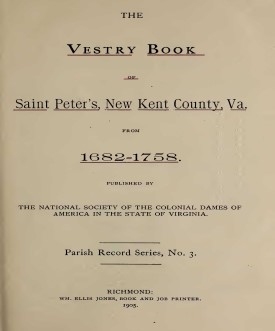
THE VESTRY BOOK OF SAINT PETER'S, NEW KENT COUNTY, VIRGINIA, 1682-1758
by National Society of the Colonial Dames of America in the State of Virginia, 1905, ii, 242 pages AVAILABLE IN ELECTRONIC (PDF) FORMAT ONLY

Saint Peter’s Parish in New Kent County, Virginia, was established on April 29, 1679. Its historic church, completed in 1703, is now St. Peter’s Episcopal Church in New Kent, VA 23124. It is one of Virginia’s oldest surviving parish churches and a National Historic Landmark.
The parish is particularly associated with Martha Dandridge Custis, later Martha Washington: the Rev. David Mossom of St. Peter’s officiated at her marriage to George Washington on January 6, 1759. The church’s parish register and vestry records are important sources for Virginia genealogy, including records from roughly 1680–1787.

To view a digital copy of the index to this book, visit Index-Spnk
(Close the pdf file with the left arrow to return to Iberian's catalog)
Add to Cart

[ESPNK] $12.00     (electronic version only


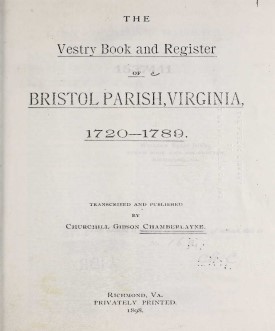
THE VESTRY BOOK AND REGISTER OF BRISTOL PARISH, VIRGINIA, 1720-1789
by Churchill Gibson Chamberlayne, 1898, vii, 418 pages AVAILABLE IN ELECTRONIC (PDF) FORMAT ONLY

Bristol Parish was part of the Church of England, the official church of Colonial Virginia. When Bristol Parish was first created in 1643, it included the valley of the Appomattox River, including Henrico County on the north side and Charles City County on the south. Prince George County formed in 1704 from Charles City County. On 31 May 1735, Dale Parish was formed, taking the part of Bristol Parish north of the Appomattox River. When Prince George County was divided, Bristol Parish became te parish for Dinwiddie County. The Vestry Book of Bristol Parish recorded births and other records from the 1720s onwards.

To view a digital copy of the index to this book, visit Index-Brpr
(Close the pdf file with the left arrow to return to Iberian's catalog)
Add to Cart

[EBRPR] $15.00     (electronic version only


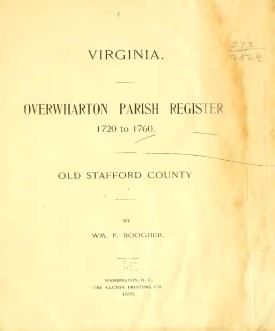
OVERWHARTON PARISH, VIRGINIA REGISTER, 1720 TO 1760
by Wm. F. Boogher, 1899, xiii, 195 pages AVAILABLE IN ELECTRONIC (PDF) FORMAT ONLY

Overwharton Parish was formed in 1680 as the upper parish or Stafford Parish. The parish was co-extensive with Stafford County, covering a part of what was once Washington Parish, extending about eighty miles along the Potomac, in breadth about four and twenty miles, embracing within its territory what is now Prince William, Loudoun, Fairfax, Alexandria Counties and a part of Fauquier until 1730, when Prince William County was taken from Stafford, and Hamilton Parish was erected, succeeding Overwharton as the frontier parish. Of the early history of Overwharton Parish and its rectors, but little is known.

The entries in the parish register consist of births, marriages, and deaths and are arranged in one continuous alphabetical sequence. The marriage records take up nearly half of the register and provide the names of the bride and groom and the date of the marriage; the birth records include the name of the newborn, date of birth, and the names of parents; and the death records give the decedent by name and date of death. In all, more than 6,000 early inhabitants of Stafford County, Virginia are preserved in this valuable resource.

Add to Cart

[EOVRP] $15.00     (electronic version only


BATH PARISH REGISTER (BIRTHS, DEATHS & MARRIAGES), 1827-1897 OF DINWIDDIE COUNTY AND ST. ANDREWS PARISH VESTRY BOOK, 1732-1797 OF BRUNSWICK COUNTY transcribed by William Lindsay Hopkins, 1989, 130 pages (8«x11), index. These two parish records have been combined into one volume as they are adjoining parishes and share some of the same family names. Bath Parish was formed in 1742 by a division of Bristol Parish in Prince George County. In 1752, Prince George County was divided to create Dinwiddie County. The current volume includes not only its own record of births, deaths and marriages but also the St. Andrew's Parish Register records for the years 1827-1838. St. Andrew's Parish was formed in 1720 from Bristol Parish and all of the parish vestry business is a part of these records including the important "processioning of lands" which took place every four years and many times names the land owners and the men who were doing the processioning. The name index includes over two thousand individuals.
To view a digital copy of the index to this book, visit Index-Bapr
(Close the pdf file with the left arrow to return to Iberian's catalog)
Add to Cart

[Bapr] $27.00


The above title is also available as a digital e-book in PDF format:
Add to Cart

[EBAPR] $20.00     (electronic version)


ST. JAMES NORTHAM PARISH VESTRY BOOK, 1744-1850 by William Lindsay Hopkins, 1987. 129 pages, index. This current volume contains all of the parish vestry business including the important "processioning of lands" which took place every four years and many times names the land owners and the men who were doing the processioning. A wonderful collection of data on early Goochland County society.

To view a digital copy of the index to this book, visit Index-Stjm
(Use your back arrow to return to Iberian's catalog)
Add to Cart

[Stjm] $20.00


The above title is also available as a digital e-book in PDF format:
Add to Cart

[ESTJM] $15.00     (electronic version)


VESTRY BOOK OF ANTRIM PARISH, HALIFAX CO., VIRGINIA, 1752-1817 transcribed by Marian Dodson Chiarito. 1983, 160 pages, 8" x 11, soft cover. Comprised of the Minutes of Meetings held by the vestry. the church was responsible only for the religious ministry of the parishioners, but also for their secular needs, e.g., general welfare. "Processioning" the property lines was also ordered by the church, and much additional information regarding area of residence and neighbors is given. (Halifax County extended west to the Blue Ridge Mountains until 1767 when Pittsylvania County was formed. Antrim Parish was created at the same time as Halifax [1752] and had the same boundaries.) A complete index of names is included.
To view a digital copy (pdf) of the index to this book, visit Index-Hvbk
(Close the pdf file with the left arrow to return to Iberian's catalog)

Add to Cart

[Hvbk] $29.95


The above title is also available as a digital e-book in PDF format:
Add to Cart

[EHVBK] $20.00     (electronic version)


SUFFOLK PARISH VESTRY BOOK,1749-1784 AND NEWPORT PARISH VESTRY BOOK, 1724-1772 transcribed by William Lindsay Hopkins. 1988, iv, 210 pages, index. Suffolk Parish Vestry Book, 1749-1784 (Nansemond County, VA) and Newport Parish Vestry Book, 1723-1772 (Isle of Wight County, VA) are presented here in one volume as they were adjoining parishes and shared some of the same family names. This abstract is taken from the two separate, bound photocopies of the two vestry books that can be found in the Archives of the Virginia State Library in Richmond, Virginia. This abstract follows the format of each vestry book and the page numbers in brackets are those found in the original book.
To view a digital copy of the index to this book, visit Index-Spvb
(Use your back arrow to return to Iberian's catalog)
Add to Cart

[Spvb] $32.00


The above title is also available as a digital e-book in PDF format:
Add to Cart

[ESPVB] $20.00     (electronic version); Note this is a large file (5-7 MB) and will be sent as a zip file


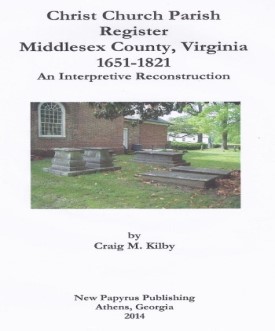
CHRIST CHURCH PARISH REGISTER OF MIDDLESEX COUNTY, VIRGINIA, 1651-1821: AN INTEPRETIVE RECONSTRUCTION by Craig M. Kilby. 2014, ix, 256 pages.
FROM THE iNTRODUCTION:
First and foremost, it is important to understand what this book is and what it is not. The goal of this book is to bring order out of chaos. It does not replace the published transcript of the Christ Church Parish records. It does, however, rearrange the maddeningly scattered material in the published transcript alphabetically by surname, and then chronologically by each surname. Hence the word "reconstruction" in the title. Doing this was much easier said than done. Hence the word "interpretive" in the title.

SURNAMES

Whenever possible, a standard spelling for each surname had be established. In some cases this was not difficult (e.g., Daniel for Danniell, Kidd for Kid). In other cases this process was more subjective. And in yet other cases several different spellings for more common names were retained (e.g. Davies and Davis, Sanders and Saunders) unless the evidence was conclusive for one spelling which was more predominant than another for the same family. In most cases, I have presented the name as given in the original in italics in the comment section for each event.

The 1988 reprint of the 1897 original added three important changes. First, it was discovered that the original index had omitted some 1200 names. Second, it added an index to the approximately 4000 slave entries that had been left out of the original index entirely. This book includes all slaves under the surname of the master. These records should not be ignored, for there might be found the only reference to a master's death that might exist, and important clues as to his widow and heirs can often be gleaned.

Most importantly, however, the authors (the Blue Ridge Committee of the National Society of the Colonial Dames of America) undertook the painstaking task of comparing the 1897 version to the original manuscript itself. Changes were not made to the original copy, but were included in an Errata section. Some of these corrections are real game changers, and unfortunately very few readers of the revised version bother to check it. They should. This book incorporates all the relevant changes to spellings of surnames. In the right hand column is found the page number of the revised register. If it also includes pages numbers 314-318, then there is information to be found in the Errata. Even if I did not incorporate the change, the reader should consult it to make his or her own determination.

Some examples of this are on page 20 where Lanson is really Lawson, and page 145, where Lawson is in fact Dawson. Or on page 11, where Edward Thacker is really Edwin Thacker. And so on.

DATES

Dates were yet another problem. The entries in this book are in segments of time, jumping wildly from one to another. Within each segment of time, the entries can only be remotely called chronological. Confounding this was the old Julian calendar where the new year began on March 25th. Then again, there are cases of the clerk "double dating" months that did not require it, such as "December 1723/24."

The normal method of treating dates between January 1 and March 24, if not "double dated" is to add a year to the year in question. This did not always make sense in context of the surrounding data. In other cases, the year was missing altogether, though in context it should be within one or two years of the surrounding entries. Then there are whole pages of entries with no year at all, where the last year given may have been, say, 1751 and the next given year is 1713. In such cases, there was no way to make even an educated guess and such entries are not included in this book.

The bottom line dates is this: if an educated guess was made on a date, it should be within one year of accuracy. If no such determination could be made, the entry was omitted. (It doesn't do much good to know that James and Mary Smith had a son John Smith born on July 19th if the year is unknown.)

Last, but not least, in many cases both a date of birth and baptism, or death and burial, were given in one entry. In such cases, I have usually only given the date of birth or death. As a rule of thumb, baptism was about a month after birth, and burial within a day or two.

The reader will note that for every entry, the page number of the published transcript is given. The reader should by all means consult it and make his or her own determination.

YEARS SPANNED: 1651-1821

Both titles of the original transcript, first published in 1897, and the revised transcript published in 1988 bear the years "from 1653 to 1812." This title has since become engrained as official "fact." This is most curious, because both the first and last entries (by date) are so unusual that it is hard to imagine how the Colonial Dames could have missed them:

(p. 41) The Age of Mr. Richard Perrott & Sarah his wife.
Richard Perrot the son of Mr. Richard Perrott, dec'd was born the 24th of February 1650 [1651 new style] being the first man child that was got and born in Rappahannock River of English parents.
(p. 161) James Steptoe and Jane Syphax were married on the 29th day of May 1819, and had a child on the 23rd day of March 1821 (mulatto child something like his father.)

Speaking of time, it should be noted that this register is my no means a complete record of the births, baptisms, marriages, deaths and burials. There are large gaps of time. What is surprising is that so many records (mostly marriages) were recorded after the Revolutionary War when the Church of England was disestablished and went into a steep decline. (See "Ministers" under Miscellaneous notes section at the end of this book.) In that vein, we are fortunate that this parish record, unlike so many others, survives at all. (It is in fact only one of sixteen surviving parish registers, and covers the longest continuous span of time of any of them.)

Moreover, Christ Church Parish was not officially established until 1666, and many of the earlier entries were either copied from older parish records or put down to paper later in time. (Again, see the "Miscellaneous Notes" for more on the history of Christ Church Parish.)

With this book, I hope to have brought at some semblance of order out of chaos. Despite my best efforts, I fully realize that with over 10,700 entries, I have made mistakes and no doubt omitted several events. I will greatly appreciate your feedback, corrections and additions.

Add to Cart

[CCPR] $36.95


The above title is also available as a digital e-book in PDF format:
Add to Cart

[ECCPR] $25.00     (electronic version)


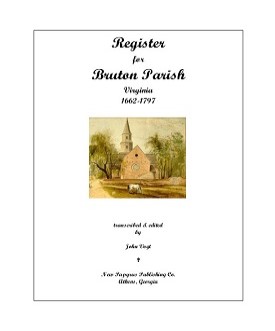
BRUTON PARISH, VIRGINIA REGISTER, 1662-1797
transcribed & edited by John Vogt. 2004, 8x10, xiv, 119 pages, index. Paperback; printed on acid-free stock.

the parish register which survives covers the years 1662, twelve years before the formation of Bruton Parish (these records are those of the earlier Middleton Parish) up past the American Revolution to the mid 1790s. It records life events for both the great men of society as well as artisans, children, servants, slaves, bastard children, and reflects a cross-section of the Williamsburg community during its heyday when it served as the capital of the colony. More than 3,400 entries list either births, baptisms, deaths, or burials. There are no marriage records.

The editor has provided a meticulous transcription of the register, using his training in colonial paleography to correct many of the previous mis-readings. A full index is included as well as an extensive introduction. This will provide valuable information for anyone with family in the York/James City/Williamsburg area during the eighteenth century.

Dating from 1715, Bruton Parish Church in Williamsburg is the third in a series of Anglican houses of worship that began in 1658. The first, which may have been at or near the 18th-century site, was built, probably of wood, in the Old Fields at Middle Plantation, Williamsburg's name until the 66-year-old community was incorporated in 1699.

Formed from Middletown and Marston Parishes in 1674, Bruton Parish was about 10 miles square. It is named for Bruton, Somersetshire, in England, the home of then-Governor William Berkeley and Virginia secretary Thomas Ludwell. As late as 1724, the parish contained only 110 families.

The church stood near the center of Williamsburg's original survey map drawn 15 years later. Its location suggested the church's importance to the colonial community's life. Virginia governors, from the time of Alexander Spotswood, were provided with a canopied chair on a platform inside the rail opposite the raised pulpit with its overhanging sounding board. Parishioners sat in boxed pews, their walls providing privacy and protection from drafts. In the early years the sexes sat apart. A vestry book entry for January 9, 1716, says: Ordered that the Men sitt on the North side of the church, and the women on the left.

Among the Williamsburg notables buried beneath the marble flagstones inside the church was Governor Francis Fauquier, one of the best loved of the colonial governors, who died in 1768. The same year an English organ was installed. Gaolkeeper Peter Pelham was hired to play it and he brought to church with him a prisoner from the Gaol, whose job it was to pump the instrument.

Among the men of the Revolution who attended Bruton Parish Church were Thomas Jefferson, George Washington, Richard Henry Lee, George Wythe, Patrick Henry, and George Mason.
To view a digital copy of the index to this book, visit Index-Bpvr
(Close the pdf file with the left arrow to return to Iberian's catalog)
Add to Cart

[BPVR] $27.00
    (printed version)


The above title is also available as a digital e-book in PDF format:
Add to Cart

[EBPVR] $15.00     (electronic version)


Charles Parish, York Co., Va, History and Registers: Births, 1648-1789; Deaths, 1665-1787 by Landon C. Bell. Published 1932; reprinted 2011, 6 x 9, xii, 285 pages.


This volume, first printed in 1932, is a transcription of the Register of Charles Parish, York County, Virginia, and it contains the earliest entries of any Virginia church record book in existence. For easy reference, the author reorganized the contents of the original register into two separate alphabetical lists, one for births (3,500+) and the other for deaths (c. 2,000). Births usually give the child's name, the names of the parents, the date of birth and, sometimes, the date of baptism. The death records indicate the decedent's full name and date of death, and, sometimes, the given name of a spouse or parent. Chapters are also included on a narrative history of the formation of Charles Parish and its relationship to York County. The historical narrative discusses the origins of the parish, controversies arising out of the election of parish vestrymen and the arrival of parish ministers and their families. A complete index of every name found in the history and among the birth and death records is provided.

To view a digital copy of the index to this book, visit Index-Cphr
(Close the pdf file with the left arrow to return to Iberian's catalog)

Add to Cart

[CPHR] $27.00     (printed version)


The above title is also available as a digital e-book in PDF format:
Add to Cart

[ECPHR] $18.00     (electronic version)


GLOUCESTER CO. VA. METHODIST RECORDS Abstracted by Michael Pollock. viii, 501pp. every-name index (10.75"x8.25"),paper.A major reason for the lack of records in Methodist churches is that historically ministers have been assigned by the bishop of the governing conference for a term of 2 years with the possibility, when the same was requested, for an extension of a further 2 years. With many ministers either being circuit riders or working part-time because their congregations were too small, most record-keeping was done by the ministers and those records generally followed the minister when he moved on to his next assignment. Those instances where the records for a specific congregation extend for a longer period of time were likely to be instances where the congregation had what is known within the Methodist Church as a "local preacher", i.e., a minister who was paid solely by his congregation, or in this specific instance, as the results of the efforts of such extraordinary individuals as Jefferson W. Stubbs, who served for 50 years as recording steward of the Gloucester Circuit of the Methodist Episcopal, South, Conference of Virginia. They survive because of the keen interest of his son William Carter Stubbs in both history and genealogy.

The detail of these records is all the more impressive when one realizes the extent of loss of records in both Gloucester and the adjoining counties of Mathews and King & Queen. With these records beginning in 1815, and reference to still earlier years, specifically details as to when individual churches were founded/built and who was responsible for the same. They may help to serve as a substitute for at least some of the lost civil records. These collections have further significance due both to the fact that officials of the Virginia Conference of the United Methodist Church were not aware of the full extent of the collection.

While the majority of the detail comes from the membership rolls, by far the bulk of the records were minutes of quarterly conferences, attended by representatives of all churches in the "circuit", which encompassed, in addition to Gloucester, and at different times, parts of King & Queen, and Middlesex, as well as Mathews Counties, though there was no consistency in either identifying the church any given "delegate" in attendance represented or even the location of any given church, there being, for example, two distinctly different references in the conference minutes for 1826 to "Old Church". These records span several different collections, some of which contain significant additional material for those other localities, Mathews being the best "represented". However, only material either specifically dealing with Gloucester or items contained within said material has been included in this work.

Add to Cart

[GCMR] $41.95     (printed version)


Gloucester Circuit (Virginia) Methodist Church Records, 1835-1837 Transcribed by Michael Pollock. vi, 132 pages,index.
This book is the result of the discovery after publication of its sister volume of a previously unknown, privately owned, manuscript, and consists of transcriptions of the contents of each page side by side with black & white images of those pages, with an every name index and table of abbreviations. Another edition, most likely as an e-book short of discovery of other volumes in the series, is planned which will also include true color images of the pages of the manuscript included in this book.
Add to Cart

[GCMC] $32.00     (printed version)


Please see our HELP PAGE for mail-order instructions, wholesaler policies and other contact information.

|| Virginia/W.Va. || General Reference || Military Records ||
|| Other States || Parish Records || E-Books || New Titles
|| Home Page || E-Books ||

Copyright 2026 Iberian Publishing Company