Iberian Publishing Company's On-Line Catalog: Louisa County Virginia
Louisa County was established on 1 Dec. 1742 from the portion of Hanover County lying above the mouth of Little Rocky Creek on the North Anna River. The new county honored the Queen of Denmark, daughter of King George II. From Louisa's new land in 1761 came the northern half of the newly created Albemarle County, and at that time Louisa reached its present configuration.
Louisa's records are complete, with the exception of the current court order book for the 1860s, which went to Richmond and was believed destroyed in the evacuation of the city. The county's deed book for the 1860s period was carried off as a souvenir by Federal troops, but was later recovered in a Baltimore hotel and bought back by the County Board of supervisors for $25!








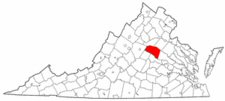 Louisa County was established on 1 Dec. 1742 from the portion of Hanover County lying above the mouth of Little Rocky Creek on the North Anna River. The new county honored the Queen of Denmark, daughter of King George II. From Louisa's new land in 1761 came the northern half of the newly created Albemarle County, and at that time Louisa reached its present configuration.
Louisa's records are complete, with the exception of the current court order book for the 1860s, which went to Richmond and was believed destroyed in the evacuation of the city. The county's deed book for the 1860s period was carried off as a souvenir by Federal troops, but was later recovered in a Baltimore hotel and bought back by the County Board of supervisors for $25!
Louisa County was established on 1 Dec. 1742 from the portion of Hanover County lying above the mouth of Little Rocky Creek on the North Anna River. The new county honored the Queen of Denmark, daughter of King George II. From Louisa's new land in 1761 came the northern half of the newly created Albemarle County, and at that time Louisa reached its present configuration.
Louisa's records are complete, with the exception of the current court order book for the 1860s, which went to Richmond and was believed destroyed in the evacuation of the city. The county's deed book for the 1860s period was carried off as a souvenir by Federal troops, but was later recovered in a Baltimore hotel and bought back by the County Board of supervisors for $25!
 LOUISA COUNTY, VA 1810 "SUBSTITUTE CENSUS" [Abstracts from the 1810 Personal Property Tax List]
by John Vogt, 2010, 5 1/2"x 8 1/2" format, viii, 14 pages, map.
LOUISA COUNTY, VA 1810 "SUBSTITUTE CENSUS" [Abstracts from the 1810 Personal Property Tax List]
by John Vogt, 2010, 5 1/2"x 8 1/2" format, viii, 14 pages, map.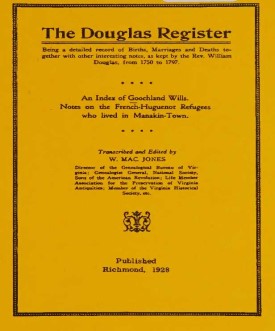 THE DOUGLAS REGISTER, Being a detailed record of Births, Marriages and Deaths together with other interesting notes, as kept by the Reverend William Douglas, from 1750 to 1797 [With an Index of Goochland Wills and Notes on the French Huguenot Refugees who Lived in Manakin-Town].
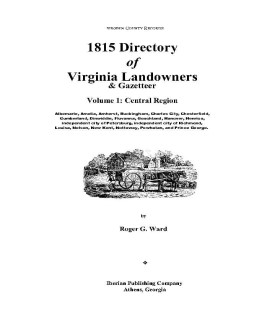 1815 DIRECTORY OF VIRGINIA LANDOWNERS & GAZETTEER, vol. 1 Central Region
(Includes the counties of Albemarle, Amelia, Amherst, Buckingham, Charles City, Chesterfield, Cumberland,
Dinwiddie, Fluvanna, Goochland, Hanover, Henrico, independent city of Petersburg,
independent city of Richmond, Louisa, Nelson, New Kent, Nottoway, Powhatan, and
Prince George.) abstracted by Roger G. Ward. 1997, vi, 239 pages, indices, maps.
1815 DIRECTORY OF VIRGINIA LANDOWNERS & GAZETTEER, vol. 1 Central Region
(Includes the counties of Albemarle, Amelia, Amherst, Buckingham, Charles City, Chesterfield, Cumberland,
Dinwiddie, Fluvanna, Goochland, Hanover, Henrico, independent city of Petersburg,
independent city of Richmond, Louisa, Nelson, New Kent, Nottoway, Powhatan, and
Prince George.) abstracted by Roger G. Ward. 1997, vi, 239 pages, indices, maps.
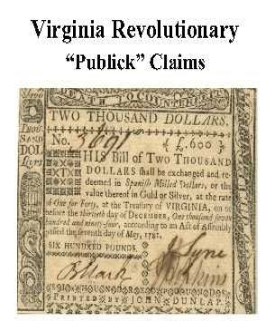 Louisa Co. Revolutionary Public Claims
transcribed by Janice L. Abercrombie and Richard Slatten.. 2005. 73 pages, 5 1/2X8 1/2.
Louisa Co. Revolutionary Public Claims
transcribed by Janice L. Abercrombie and Richard Slatten.. 2005. 73 pages, 5 1/2X8 1/2.


